
| User Roles |  Admin |  Staff contributor | ✗External contributor | ✗Pulse user |
When you export documents or templates that include attachments, you may see a warning message related to fonts. This article explains what these warnings mean, why they occur, and what you can do about them.
Table of contents
- What does the font warning mean?
- Is this a blocking error?
- Why are some fonts not supported?
- How can I check which fonts are supported?
What does the font warning mean?
The warning tells you that some of the fonts used in your PDF attachments are not supported by Silverfin.
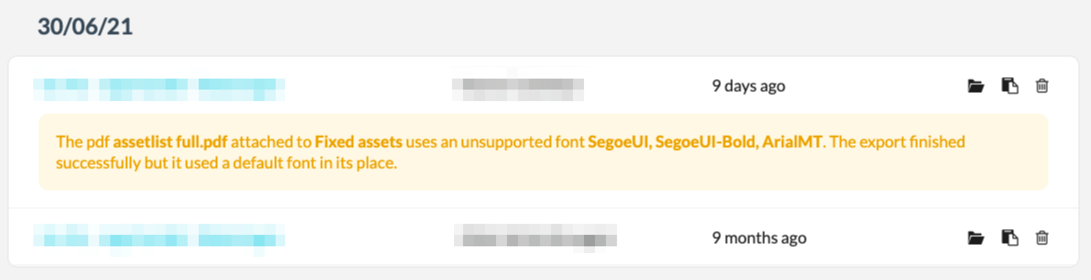
Instead of displaying unreadable characters or dots, we automatically replace these fonts with our default supported font, so your export stays readable.
Is this a blocking error?
No, this is not a blocking error. The export process completes successfully, and the warning is only there to tell you that some fonts have been substituted.
The attachments in your export may look slightly different from the originals, but the content is still accessible and legible.
Why are some fonts not supported?
There are two main reasons:
- PDF compatibility issues: PDF files are created by many different software tools, and font handling varies between them. Fonts that work perfectly in one program are sometimes not recognised correctly when another program processes them, which causes the font substitution warning.
- Legal restrictions: Many fonts have licensing restrictions that prevent embedding or redistribution. Even where it is technically possible, we cannot support these fonts without the proper licences. Some fonts are legally forbidden from being embedded in PDFs.
How can I check which fonts are supported?
Admin users can view the list of fonts that Silverfin supports in the Style Settings of any style bundle at firm level. This helps you understand which fonts will be preserved during export. For more about working with style bundles, read How to update the style bundle?
If you have any questions or need further help with font support in exports, contact our support team.