
| User Roles |  Admin Admin |  Staff contributor Staff contributor | ✗External contributor | ✗Pulse user |
The Holiday accrual account template builds a per-employee working paper for the cost of holiday pay accrued but not taken at the period end (plus the associated employer National Insurance), and reconciles that calculated liability to the balance on the account it is attached to. This article explains when to use it, how the Simple and Complex modes differ, and how the reconciliation and adjustment work. It is relevant for UK teams preparing holiday pay accruals in the Working Papers workflow.
Table of contents
- When should I use this template?
- What do I need before I start?
- What does this template calculate?
- How do I choose between Simple and Complex?
- How do I complete the Simple employee schedule?
- How do I set the statutory leave year and working days (Complex)?
- How do I complete the Complex employee schedule?
- How do I reconcile to the account?
- How do I post the adjustment?
- What flows through to the rest of the accounts?
- What rolls forward next year?
- Where does the data come from?
- Frequently asked questions
When should I use this template?
This is one of two Silverfin UK templates called Holiday accrual. This one is an account template, attached directly to the specific liability account in the chart of accounts, so it always reconciles to that one account. The other is the Holiday accrual reconciliation, a standalone reconciliation added to the Working Papers workflow that does the same calculation but lets you pick which account(s) to reconcile against instead of being tied to one. Both use the same Simple/Complex calculation logic.
Use this account template where the firm attaches working papers directly to balance sheet accounts (via add template on the account in the chart of accounts). Attach it to the nominal code that carries the year-end accrued holiday pay liability (and employer NI, if accrued in the same account). If the firm instead prefers adding a fixed reconciliation to the workflow list and choosing the account(s) inside the template itself, use the Holiday accrual reconciliation instead — that article covers the account-picker version.
Don't run both templates for the same balance — pick whichever matches how the firm's workflow is built.
What do I need before I start?
- Identify the liability account(s) that hold the closing accrued holiday pay balance, and attach this template to the relevant account.
- Decide Simple or Complex before entering data — the two options use separate tables, so switching later starts a fresh schedule rather than carrying data across.
- Gather employee salary and leave records: annual salary, annual holiday entitlement, start dates, holidays taken, and any brought-forward balance.
What does this template calculate?
Holiday pay accrued but not yet taken at the period end is a short-term employee cost, so the template calculates it on an undiscounted basis and combines it with the associated employer National Insurance (currently hard-coded at 13.8%, marked in the code for review as the rate changes) to arrive at the Total Accrual — the figure this working paper reconciles to the balance on the account it's attached to.
How do I choose between Simple and Complex?
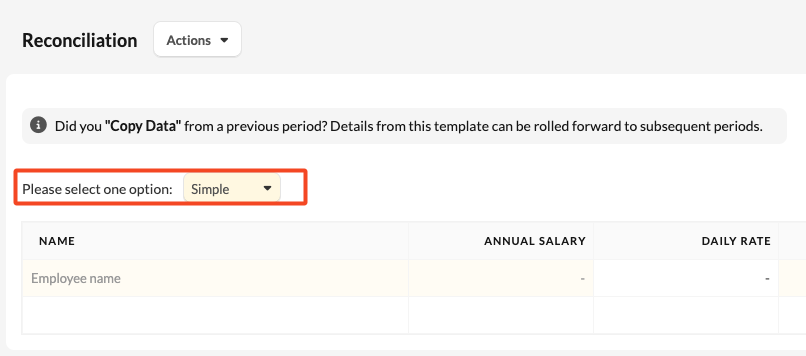
A dropdown ("Please select one option") lets you pick Simple or Complex (defaults to Complex).
- Simple — a quick one-row-per-employee schedule based on annual salary and the number of accrual days outstanding at the period end. No brought-forward tracking.
- Complex — a full statutory-leave-year schedule that tracks entitlement, days taken, and brought-forward/carried-forward balances, and rolls the closing balance forward automatically each year.
An infotext banner ("Did you Copy Data from a previous period?") appears automatically in any period after the first, reminding you that details can be rolled forward — this is informational rather than a control you fill in.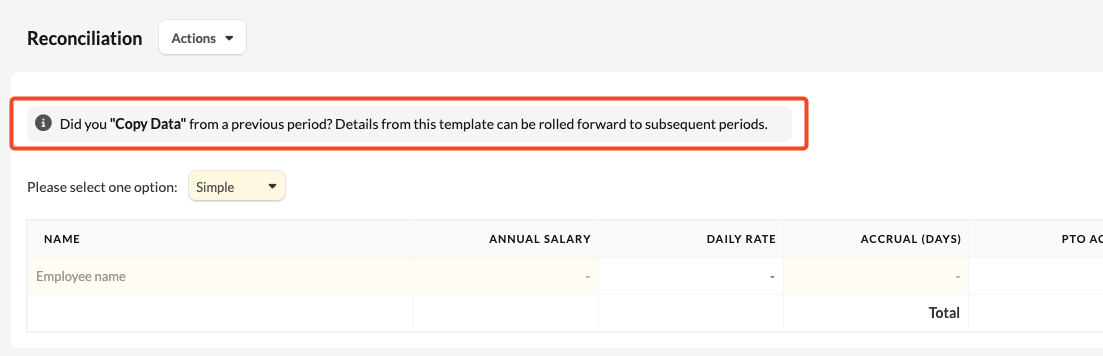
How do I complete the Simple employee schedule?
For each employee enter Name, Annual salary, and Accrual (days) — the number of outstanding leave days at the period end. The template calculates the Daily rate (salary ÷ 260 working days, not user-editable in Simple mode), PTO accrual (daily rate × accrual days), Employer NI (PTO accrual × 13.8%), and Total Accrual (the sum of the two). Add one row per employee.
How do I set the statutory leave year and working days (Complex)?
Enter the Statutory leave year start and end dates (the 12-month leave year the entitlements relate to) and the Working days per annum (defaults to 260) used to derive the daily rate from annual salary.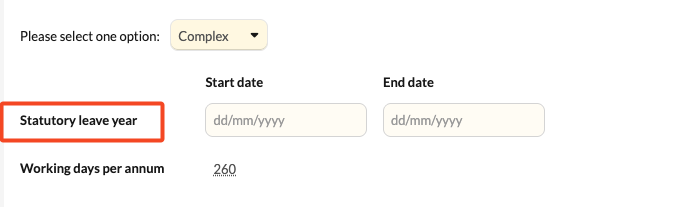
How do I complete the Complex employee schedule?
For each employee enter Name, Start of Employment, Annual holiday entitlement (days), B/F (balance brought forward), Holidays taken, and Annual Salary. The template calculates Days entitled (the number of days from start of employment, or the statutory year start if later, to the period end), Leave accrued (entitlement pro-rated by days entitled ÷ 365), Holiday accrual (leave accrued + B/F − holidays taken), PTO Accrual (annual salary ÷ working days × holiday accrual), Employer NI, and Total Accrual.
Only rows that have already been saved calculate — a newly added blank row shows no figures until saved.
How do I reconcile to the account?
The Total Accrual is compared automatically to the balance on the account the template is attached to. For periods ending after 30 June 2023, both Simple and Complex show a reconciled tick when the figures tie out exactly. For the Simple option in periods ending on or before 30 June 2023, no automatic reconciliation check is shown (a legacy carve-out retained so older periods aren't retrospectively flagged).
Where a difference remains, an Explanation of differences section appears — add a description and amount per item until the gap is explained — and a Total after explanation line shows an unreconciled indicator (with the account value, template value and remaining difference) if it still doesn't agree.
How do I post the adjustment?
If a difference remains (before or, if used, after explanation), a Post [amount] adjustment button appears. Clicking it books a journal between the account the template is attached to and a fixed P&L account (700100.000), described as "Holiday accrual adjustment", to true the balance sheet account up to the calculated accrual.
What flows through to the rest of the accounts?
The Total Accrual supports the accrued holiday pay (and employer NI) included within accruals/other creditors on the balance sheet, and any adjustment posted moves the P&L staff-costs account (700100.000). This feeds the accruals/creditors figure on the balance sheet and the staff costs note in the accounts.
What rolls forward next year?
In Complex mode, each employee's closing Holiday accrual becomes next period's brought-forward (B/F) figure automatically once the statutory year has passed its end date; the employee list, salary and dates roll forward via the normal Copy Data process. The statutory leave year dates and working days per annum also roll forward but should be reviewed each year the leave year changes.
Simple mode has no brought-forward field — each period's accrual is calculated fresh from the days outstanding entered at that date.
Where does the data come from?
Employee names, salaries, leave entitlement and days taken are entered manually (or copied forward) inside the template. The reconciliation figure is the balance on the account this template is attached to in the trial balance. The employer NI rate (13.8%) is hard-coded in the template and needs a template update if the statutory rate changes.
Frequently asked questions
Why doesn't the Simple option show a reconciliation check?
For periods ending on or before 30 June 2023, no automatic tie-out is shown for Simple. Use Complex, or a later period, if reconciliation is required.
Which account should I attach the template to?
The nominal ledger code that carries the closing accrued holiday pay (and employer NI, if combined) balance — check the firm's account mapping.
What's the difference between this and the Holiday accrual reconciliation?
This account template is attached to one specific account and always reconciles to it. The Holiday accrual reconciliation is a standalone item in the workflow where you pick the account(s) to reconcile against via an account-range selector, and it also lets you attach supporting evidence as a file. The employee calculations are otherwise very similar, though the Complex mode pro-rates entitlement slightly differently between the two (by days here, by months in the reconciliation).
Can I switch between Simple and Complex mid-year?
Data isn't shared between the two tables, so switching starts a fresh schedule — decide which to use before entering figures.